Tuesday, September 18, 2007

Autumnal bare bloomers

On Friday afternoon and evening the garden finally had a good rainfall, receiving almost 2 inches (4.5 cm) after two months with very little precipitation and temperatures well above average. The rain, along with the autumnal air mass that followed it, brought many geophytes into flower this week. All of these "bulbs" are unusual because they bloom in late summer and autumn without any foliage present.


Lycoris radiata, a native of China, has spidery red flowers with long, exserted filaments. After blooming, the tidy, dark green leaves, with a pale central stripe, emerge and add attractive greenery to the garden all winter, disappearing as the bulbs enter dormancy in the spring.


Close-up of Lycoris radiata
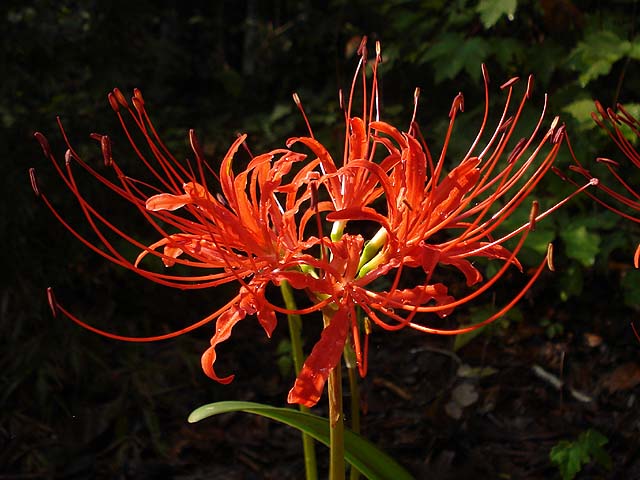
Lycoris radiata


Group of Lycoris radiata
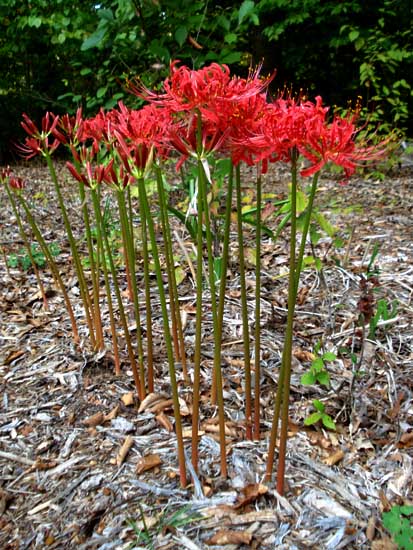
Lycoris radiata


Rhodophiala bifida, a native of Uruguay and Argentina, also has red flowers on bare scapes, but the flowers have a different look. The narrow leaves emerge from its long-necked bulbs after the flowers, remain green all winter and go dormant in the spring, but they're long and sprawl around, rather than remaining tidy like those of Lycoris radiata.


Group of Rhodophiala bifida
Rhodophiala bifida


Not all of these autumn bloomers are red, these Colchicum have pinkish-purple flowers. Unlike the others here, its broad foliage doesn't emerge from its corms until late winter, going dormant in late spring.


Close-up of Colchicum
Colchicum


Cyclamen hederifolium, native to Southern Europe, has pale pink flowers, shaped like shuttlecocks, that arise from flattened corms. It has a long blooming season, during most of the autumn, and the later flowers are joined by dark green, triangular leaves with gorgeous silver markings.


Close-up of Cyclamen hederifolium
Cyclamen hederifolium
Sunday, September 9, 2007

Variegated Hedychium

Back in June I had an early Hedychium bloom, but most Hedychiums bloom here during late summer and early autumn. Nearly all of these gingers have showy flowers and many are also intensely fragrant. Out of bloom they make attractive foliage plants with long tapered leaves alternating along arched stems. There aren't many with variegated leaves, I've got the only two I know of happily growing in the garden.


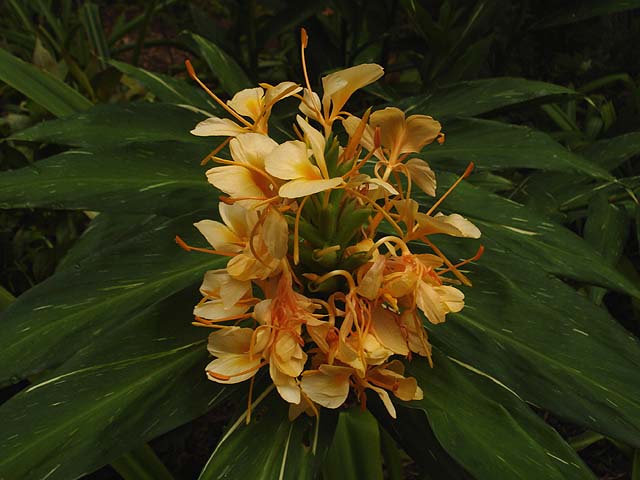
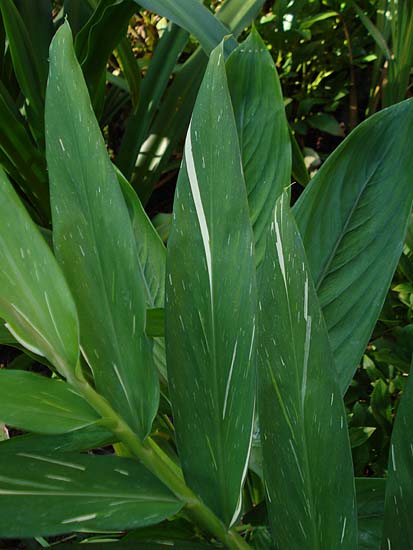
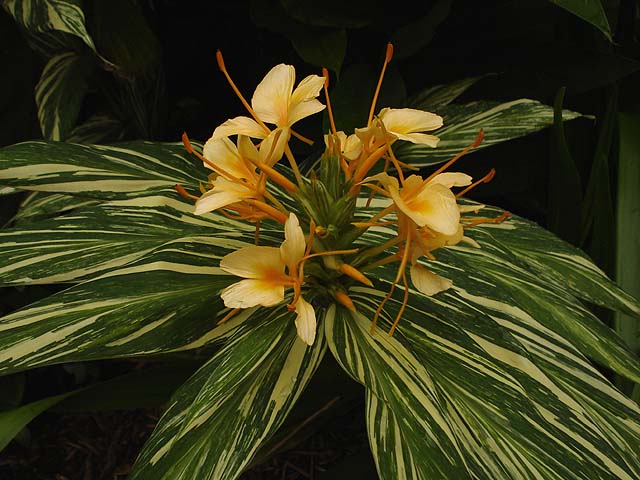
Hedychium 'Dr. Moy' has subtle variegation, a mixture of grayish-green, sometimes white, streaks and speckles on a medium green background. Without the variegation it would still be an excellent Hedychium because it has very sturdy stems which bear broad foliage and large heads of very fragrant, light orange flowers with darker orange throats. It is a hybrid of H. flavum × H. coccineum and was bred by and named after Dr. Moy, a botanist, now retired, at San Antonio Botanical Garden.


Hedychium 'Dr. Moy' flowers
Hedychium 'Dr. Moy'


Close-up of Hedychium 'Dr. Moy' foliage
Hedychium 'Dr. Moy'

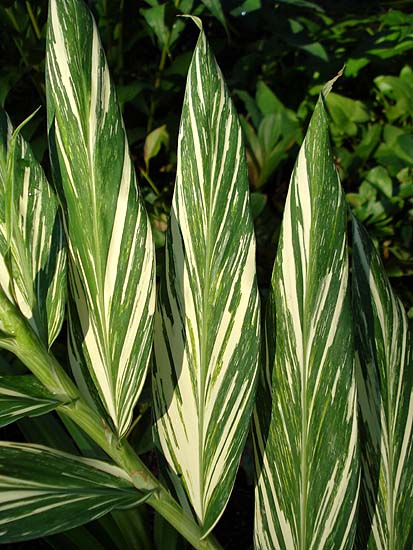
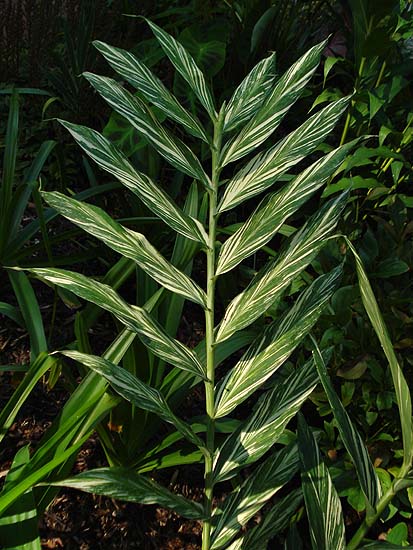
Hedychium 'Vanilla Ice' is a sport of 'Dr. Moy' with very dramatic variegation consisting of abundant white streaks. Its flowers and growth habits are the same as 'Dr. Moy', and although the loss of chlorophyll reduces its vigor, it's still a decent grower. It was selected and propagated by Messenbrink's Nursery of Nashville, North Carolina.


Close-up of Hedychium 'Vanilla Ice' foliage
Hedychium 'Vanilla Ice'


Hedychium 'Vanilla Ice' foliage
Hedychium 'Vanilla Ice'


Hedychium 'Vanilla Ice' flowers
Hedychium 'Vanilla Ice'

Wednesday, August 29, 2007

Hippeastrum reticulatum striatifolium

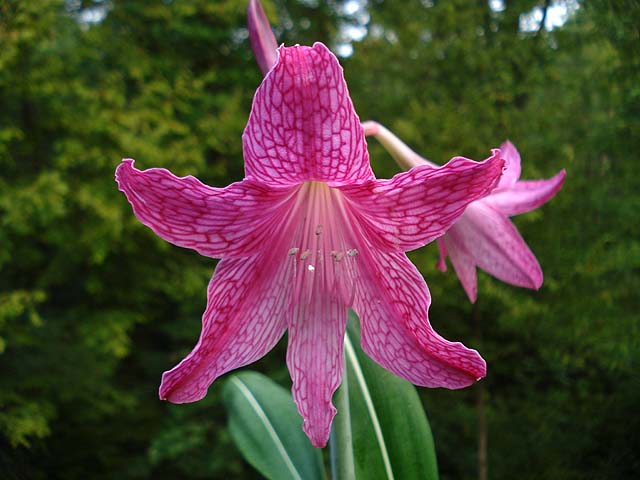
Hippeastrum reticulatum striatifolium is quite a mouthful, but it's also a very descriptive name. Reticulatum refers to the net-like veining in the flowers while striatifolium refers to the white stripe down the center of each leaf, both are features readily observed in the photograph. This beauty is not planted in the garden, it's potted in a decorative container and spends most of the year on the porch, except during winter when it's in the house.


Hippeastrum reticulatum striatifolium

Saturday, August 25, 2007

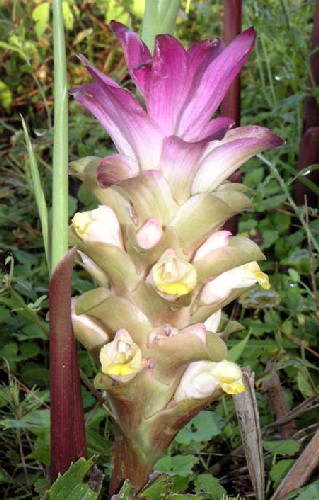
Curcuma

Curcuma is a genus in Zingiberaceae family with about 80 species native to Asia. The rhizomes of Curcuma longa are ground to make turmeric, an orange-yellow powder used as a spice in curries. Other species are cultivated for their showy flowers and bold foliage, but they also have aromatic rhizomes, leaves, and stems even though they're not cultivated for turmeric production. The two best performers in the garden so far I grow mostly for their foliage.


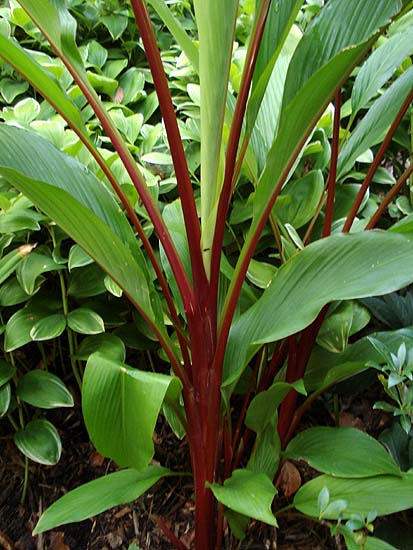
Curcuma rubescens has bright red petioles supporting its large green leaves. In bright light, with sufficient moisture, even the leaves will produce red pigments, although never as dark as the petioles. It's known to have showy spring flowers too, but my plants have been reluctant to bloom so far. If they bloom someday that will be great, but even without I am happy.


Curcuma rubescens petioles
Curcuma rubescens


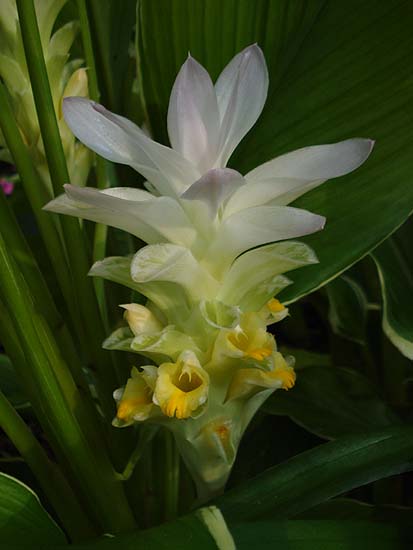
'Emperor' is an attractive selection of Curcuma petiolata with excellent variegated foliage, green with a variable creamy margin. It also produces summer flowers, but they're subtle when compared with many Curcuma flowers. They're also mostly hidden by the foliage so they don't really contribute to the overall garden scene, but it's worth your while to part the foliage and take a peek if you enjoy unusual flowers.


Curcuma petiolata 'Emperor' flower
Curcuma petiolata 'Emperor'


Curcuma petiolata 'Emperor' foliage
Curcuma petiolata 'Emperor'


Both of these plants are very slow to emerge in the spring, often not showing above ground until late May, causing the gardener to wonder if the cold weather from the previous winter has killed them. However, once they start to grow they do so very rapidly, reaching full height in just a few weeks.

Friday, August 24, 2007

Yes! We have pink bananas!

We have pink bananas today! Not only are these bananas pink, they're also cute and fuzzy, too bad they're really seedy and not edible.


Musa velutina fruits
Musa velutina


They belong to Musa velutina, a small banana that grows about 7 feet (2m) tall and is winter hardy here in Raleigh, North Carolina. Its large leaves give the garden a tropical look from late spring until frost, with additional interest provided by the pink flowers in late summer, followed by the attractive, and unusual, pink fruits. I got my first plants a few years ago from my buddy Bodhisagan, the owner of this blog, and this year I had enough to share with another friend.


Musa velutina
Musa velutina


Musa velutina inflorescence
Musa velutina

Sunday, August 19, 2007

Late Summer Crinum Favorites

Two favorite Crinums are blooming in the garden now, both are hybrids that have one New World parent, either the Southeastern United States native, Crinum americanum , or its South American counterpart, Crinum erubescens. Both of these species have very fragrant, spidery, white flowers with dark pink filaments. They also thrive on moist soils, as do their hybrids.


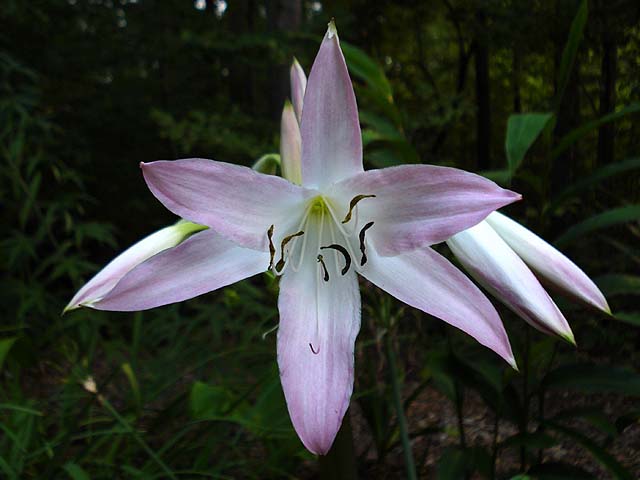
Crinum 'Summer Nocturne' is Thad Howard's cross of Crinum erubescens with Crinum moorei. It has large, wide open, sweetly fragrant, white flowers with pink tips. Its tall, purple scapes contrast nicely with its lush, green foliage.


Crinum 'Summer Nocturne'


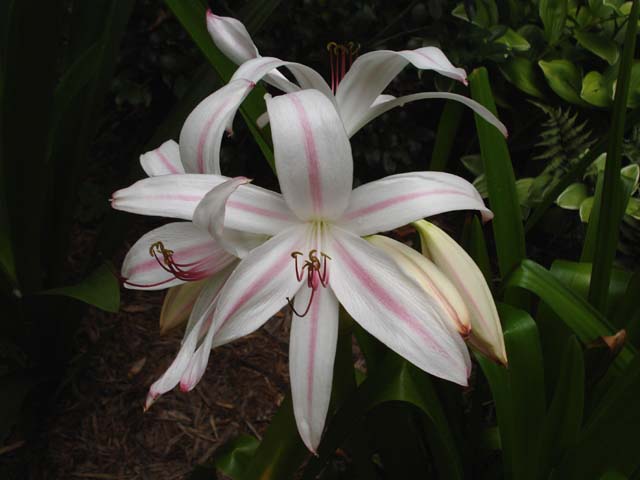
Crinum 'Royal White' is the first of the ×digweedii hybrids (Crinum americanum × Crinum scabrum) to bloom in the garden, although a walk around the garden today revealed that others are getting ready. Like 'Summer Nocturne', 'Royal White' also has sweetly fragrant, wide open, white flowers, but instead of pink tips it has pink stripes.


Crinum 'Royal White'

Thursday, August 9, 2007

Xanthosoma

Xanthosoma, along with Colocasia, Alocasia, and other genera with large leaves in the Arum (Araceae) family, are commonly called Elephant's Ear. Xanthosoma is a New World genus with about 50 species, all native to Central and South America. Their large leaves make them attractive ornamentals and some species are also cultivated for food, mostly for their tubers, but the young, unfurled leaves are also eaten.


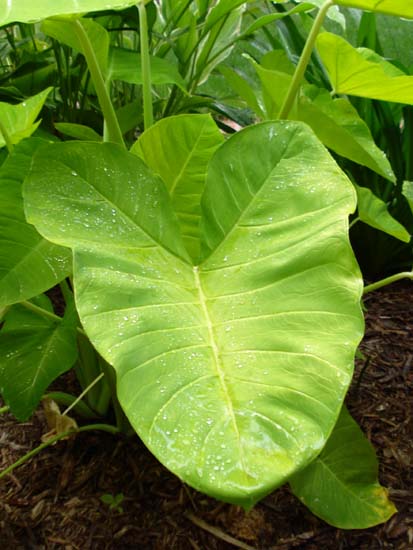
Xanthosoma mafaffa 'Lime Zinger' has a great name because its huge leaves are a shade of chartreuse that's sometimes called Day-Glo yellow. It's a slow grower during the spring, but grows rapidly once hot, humid, summer weather arrives. From a tuber about the size of a baseball, set out after the last spring frost, it can easily grow 6 feet tall and 6 feet wide by the end of the summer if provided with moist, rich soil and partial sun. In the past I've dug mine for winter storage, not a difficult task despite the plant's huge size, but I have enough tubers now to store some and also leave some out for testing.


Close-up of Xanthosoma mafaffa 'Lime Zinger' foliage
Xanthosoma mafaffa 'Lime Zinger'


Xanthosoma mafaffa 'Lime Zinger'


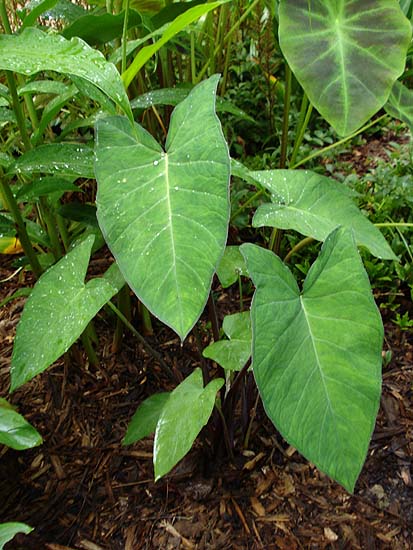
If 'Lime Zinger' has you reaching for your sunglasses then Xanthosoma violaceum will have you removing them. That's because its leaves are a cool blue-green with purple margins. Its petioles are also purple and on a healthy specimen there's often a purple overlay on the upper leaf surfaces. I haven't been growing this one for long so I'm not sure if it will mature as large as 'Lime Zinger', but I sure hope so.


Xanthosoma violaceum


Close-up of Xanthosoma violaceum petiole
Xanthosoma violaceum